EN
EN
 FR
FR






Co-authored by Cologix, Cohesio Architecture, CBD Dionne and WSP
When Cologix’s Montreal MTL8 facility earned LEED (Leadership in Energy and Environmental Design) Gold certification LEED® , it joined a select group of Canadian colocation data centers recognized for exceptional environmental performance. Yet what truly differentiates MTL8 is not just the certification itself – it is the rigor and intentionality behind every design decision. Sustainability wasn’t an add-on late in the process. It was embedded from the outset as a core performance objective.
The result is a large-scale, AI-ready Scalelogix℠ data center that delivers high-density digital infrastructure while advancing environmental stewardship, community responsibility and long-term operational efficiency.
A Site Designed to Strenthen Local Biodiversity
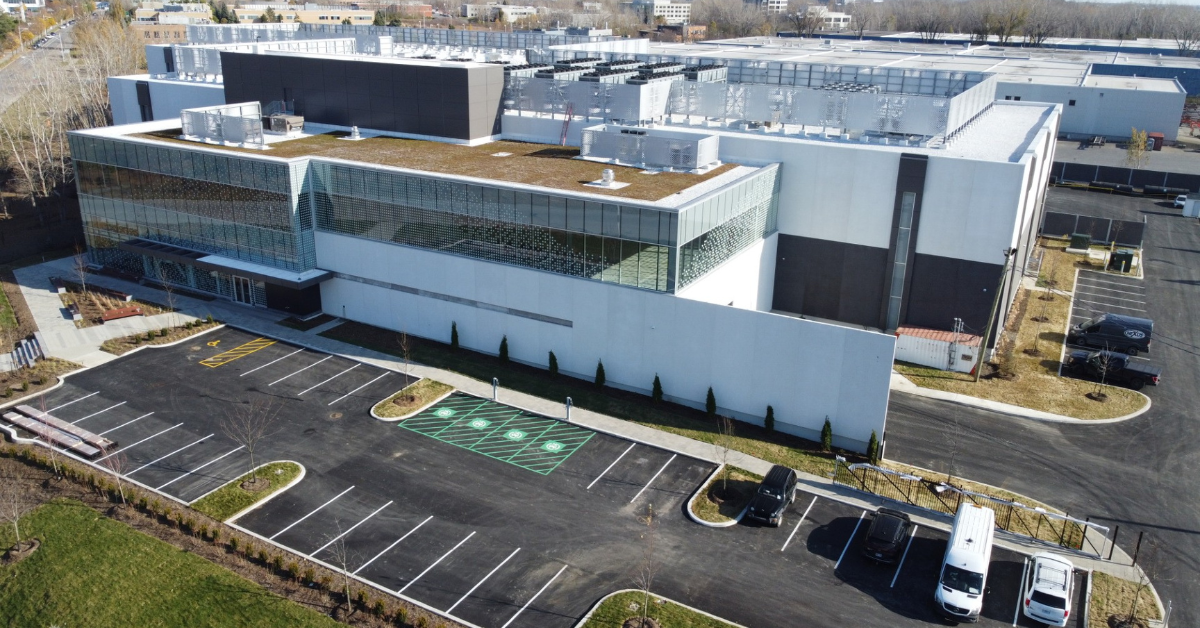
MTL8 spans 206,000 SQFT within Technoparc Montréal, Canada’s first science park for research and development in clean technology, nanotechnology and sustainable development. Before construction began, the site underwent extensive environmental assessments that led to a long-term reforestation and biodiversity plan that goes far beyond typical commercial landscaping. The project preserved more than 80 existing trees and revitalized the landscape with more than 500+ newly planted, indigenous trees alongside diverse shrubs and groundcover. More than 97% of the site’s vegetated green space was maintained, far exceeding conventional commercial development standards. A long-term biodiversity plan was also implemented to protect the nearby Bertrand Stream ecosystem, helping restore native vegetation, strengthen local biodiversity and improve the ecological resilience across the site.
Powered by More Than 99% Renewable Energy
MTL8 is powered by more than 99% renewable energy through Hydro-Québec’s hydroelectric grid, one of the cleanest electricity systems in North America. This access to stable, renewable power significantly lowers the data center’s carbon footprint while supporting both customer sustainability objectives and Cologix’s broader ESG goals. By pairing stable, renewable hydropower with high-density design, MTL8 delivers the performance required for modern AI and cloud workloads without compromising environmental responsibility.
A Quiet, Clean Approach to High-Density Infrastructure
MTL8 was intentionally engineered to minimize noise, manage airflow around the building and reduce off-site environmental impact. Generators, rooftop units and cooling systems meet strict performance standards. Smaller, modular cooling units were chosen instead of traditional large-scale industrial systems to reduce noise and allow more precise thermal control. Ventilation and exhaust systems were also placed in locations that would not affect neighboring properties. These controls exceed standard LEED requirements and demonstrate Cologix’s commitment to being a responsible, long-term community partner.
Where Smart Cooling Meets Responsible Water Use
By utilizing Montréal’s cold climate to help cool the facility for much of the year, MTL8 cuts energy use significantly, contributing to its annualized PUE below 1.3, compared to the industry average of approximately 1.56. Equally important, MTL8 uses closed-loop refrigerant systems equipped with real-time monitoring to track key operational and environmental conditions to ensure both reliability and performance optimization. Water stewardship is equally prioritized. The data center also incorporates a closed-loop greywater reuse and rainwater recovery system, supporting stormwater management and reducing demand on municipal water supplies. Together, these systems make MTL8 highly water-efficient, while still supporting the growing demands of high-density workloads.
Sustainable Materials and High-Performance Building Systems
Reducing environmental impact across the building lifecycle was a central design objective. MTL8 integrates sustainable materials and design features to reduce embodied carbon while improving durability and resilience. Key sustainability features include:
High-Performance Green Roof
MTL8’s high-performance green roof extends the data center’s sustainability impact to the surrounding environment in several meaningful ways. Vegetation absorbs rainfall, slows runoff and naturally filters pollutants before they reach local waterways. It also improves air quality by capturing particulates and carbon dioxide, while releasing oxygen back into the environment.
By protecting the roofing membrane from UV exposure and temperature extremes, the green roof can extend roof lifespan by two to three times, while also providing insulation, passive cooling and micro-habitats that support local bird populations.
Locally Sourced and Low Impact Materials
Instead of importing standard concrete panels, MTL8 integrates locally manufactured Québec panels produced with environmentally friendly mixes that include recycled materials. These insulated panels are built to last, providing strong energy efficiency and reducing the need for future maintenance, lowering resource use throughout the data center’s lifecycle.
Interior materials were selected to support healthy indoor air quality and long-term durability. Rather than relying on finishes that wear quickly, the design prioritizes durable, low-emitting materials such as polished concrete floors, FSC-certified wood, and minimal carpeting, supporting LEED indoor air quality standards and perform well over time. These choices create a healthier interior environment that reduces the need for frequent material replacement over time.
A Model for the Next Generation of Sustainable Data Centers
MTL8 exemplifies Cologix’s commitment to building innovative, environmentally responsible data centers. By restoring natural landscapes, sourcing materials responsibly and optimizing energy and water efficiency, Cologix has set a new benchmark for colocation sustainability in Canada.
Importantly, the design and buildout of MTL8provided valuable insights and best practices that can be applied across future developments. While LEED certification offers a formal framework, the underlying principles—intentional design, measurable efficiency and long-term environmental value—benefit the data center industry as a whole.
As AI and high-density workloads drive unprecedented infrastructure, projects like MTL8 illustrate a path forward – one where performance and environmental stewardship advance together to support a more sustainable digital future.
MTL8 and LEED Certification FAQs
What is LEED® certification, and what is the significance of a LEED-certified data center?
LEED® (Leadership in Energy and Environmental Design) certification is a globally recognized standard for sustainable building design, construction and operation. A LEED-certified data center meets strict criteria for energy efficiency, water conservation, material selection and environmental impact.
What is PUE, and why is MTL8’s lower-than-average score noteworthy?
Power Usage Effectiveness (PUE) measures how efficiently a data center uses energy by comparing total facility power to IT equipment power. MTL8’s annualized PUE of 1.3 is significantly lower than the industry average of 1.56, indicating a more efficient use of resources.
What is a closed-loop water cooling system, and why is it important?
A closed-loop water cooling system recirculates water within a closed loop rather than continuously drawing from municipal supplies. At MTL8, closed-loop refrigerant systems, greywater reuse and rainwater recovery reduce water consumption while maintaining reliable cooling performance. This approach supports water stewardship and minimizes environmental impact.
How will the design and development of MTL8 inform future Cologix locations?
MTL8 serves as a blueprint for future Cologix data centers by demonstrating how sustainability, scalability and high-density performance can be integrated from the earliest design stages. Lessons learned around energy efficiency, water management, material selection and community impact are being applied to future developments, enabling Cologix to deliver consistent, environmentally responsible infrastructure as customer demand for AI-ready capacity continues to grow.
How do Cologix’s sustainability initiatives set it apart from other Data Center/Colocation providers?
Cologix differentiates itself by embedding sustainability as a core design principle rather than just a compliance requirement. From renewable energy sourcing and biodiversity restoration to efficient cooling, water reuse and durable, low-impact materials, Cologix takes a holistic, long-term approach. This strategy delivers measurable environmental benefits while supporting customers with reliable, scalable infrastructure that align with ESG and performance expectations.