EN
EN
 FR
FR






In a recent TechStrong article examining the infrastructure demands of AI superintelligence, industry leaders (including Cologix VP of Hyperscale and Cloud Sales, Bill Bentley) discuss how the race to advanced AI is fundamentally reshaping data center requirements. As Meta announces TBD Labs and organizations like OpenAI and Safe SuperIntelligence Inc. push toward systems surpassing human intelligence, the spotlight shifts from algorithms to the gigawatt-scale infrastructure powering these breakthroughs.
The article highlights a critical insight from NVIDIA CEO Jensen Huang: next-generation AI models will require “100 times more compute than older models.” This exponential demand is driving what the piece calls “intelligence-scale systems”—infrastructure far beyond traditional data center capabilities. With IDC projecting AI-centric system spending to reach $632 billion by 2028, the urgency for purpose-built AI infrastructure has never been greater.
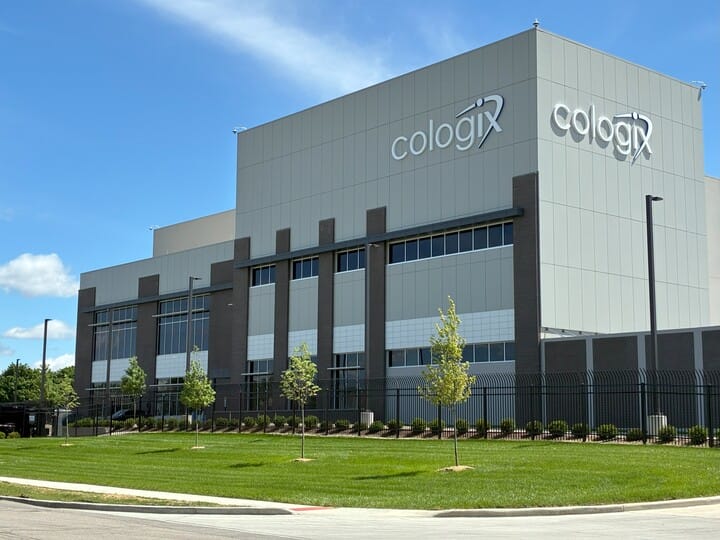
Spotlighting Columbus, Ohio (location of five Cologix data centers) as “The First Superintelligence Cloud Deployment,” the article features the groundbreaking partnership between Lambda, Cologix and Supermicro. This real-world deployment demonstrates how Cologix’s Scalelogix™ data center (COL4) addresses the extreme requirements that AI now demands: massive parallelism across tens of thousands of GPUs, ultra-low latency networking and energy-optimized clusters supporting 44kW+ per rack.
What distinguishes Cologix in this transformation is our comprehensive ecosystem approach. While the article notes that “one hyperscaler recently experienced an unexpected failure roughly every three hours” across a 16,384 GPU cluster, Cologix employs a range of proactive strategies – including on-site parts depots and technical staff – to deliver the infrastructure-resilience necessary in the era of superintelligence.
A crucial truth is now clear: traditional data centers weren’t designed for AI’s unprecedented demands. Success in the superintelligence race belongs to those with “the fastest, most flexible and best supported infrastructure.” Cologix’s network-neutral platform, connecting 710+ networks across 12 strategic markets, delivers precisely that competitive advantage for our customers.
AI Infrastructure FAQs
1. How does Cologix’s Columbus location benefit AI companies and enterprises?
Columbus offers strategic advantages for AI infrastructure: proximity to major enterprise markets across the Midwest and East Coast, robust fiber connectivity, competitive power costs and Cologix’s interconnected ecosystem of 710+ networks and 350+ cloud providers. Our COL4 Scalelogix facility specifically supports high-density AI workloads with gigawatt-scale capacity and ultra-low latency connections to major cloud platforms.
2. What is Scalelogix and how does it support AI workloads?
Scalelogix is Cologix’s hyperscale edge data center solution designed for AI-era demands. It can provide high-density power delivery, advanced cooling systems (including liquid-ready infrastructure), ultra-low latency interconnection and seamless scalability. Unlike traditional colocation, Scalelogix facilities are purpose-built to handle the extreme power, cooling and connectivity requirements of large-scale AI training and inference workloads.
3. How quickly can Cologix deploy AI infrastructure for time-sensitive projects?
Speed is critical in the AI race. At our Columbus COL4 facility, Lambda successfully deployed 4,000 GPUs in under 90 days, demonstrating our rapid deployment capabilities. This speed comes from our pre-engineered Scalelogix infrastructure, established supply chain partnerships, on-site technical teams and streamlined processes designed specifically for high-density AI deployments.
4. What makes AI infrastructure different from traditional data center requirements?
AI workloads are pushing the frontiers for power density (inferencing deployments are beginning to demand 40+kW per rack vs. traditional 5-10kW), requiring advanced cooling systems including liquid cooling capabilities, ultra-low latency networking for GPU-to-GPU communication and massive scalability to support training clusters with tens of thousands of processors. Traditional data centers simply weren’t architected for these extreme computational and thermal demands.
5. What reliability and support advantages does Cologix offer for mission-critical AI workloads?
AI training and inference workloads can’t tolerate frequent interruptions. Cologix employs a range of proactive strategies – including on-site parts depots and technical staff – to deliver the infrastructure-resilience necessary in the era of superintelligence. This diversified approach to resilience mitigates the reliability issues that may plague large AI clusters.